
Decolonizing our gaze
This article traces the realizations that emerged in the field during my first documentary project in Tiwanaku, Bolivia. Through my questioning, I explore the responsibility of the gaze when filming communities historically marked by colonization. Between doubt, self-reflection, and learning, I examine my position as a European woman and advocate for an approach grounded in co-creation, consent, and reciprocity. Decolonizing the gaze thus becomes a concrete commitment: filming with, not on, in order to make representation a space of dignity, transmission, and shared pride.
Anaïs PAJOT
1/8/20263 min read
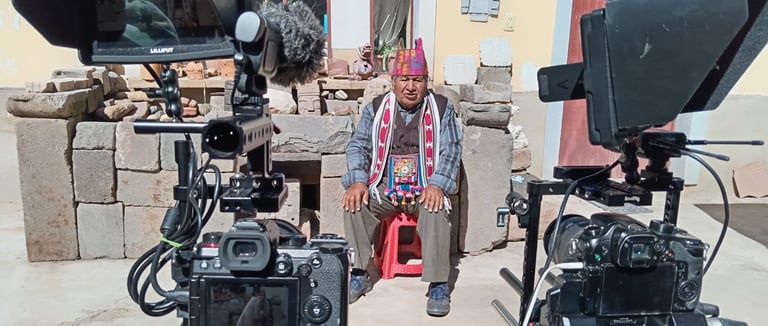
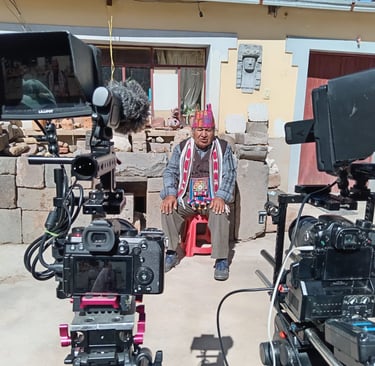
Subsequent projects with other communities multiply my questions: What needs and challenges are Indigenous peoples currently facing? How can my work serve their interests while also allowing me to find financial balance? Could my work negatively impact the individuals or collectives I collaborate with?How can I ensure that the projects carried out truly serve the interests of the communities and guarantee reciprocity toward participants?How can I avoid exoticizing or folklorizing cultures and prevent any form of cultural appropriation? How can I involve the protagonists in the creation process while preserving my own creativity?How can I understand the socio-cultural filters that shape my perspective in order to create projects that place my creativity at the service of communities?What position should I adopt as a white female photographer and filmmaker collaborating with Indigenous peoples?What is my legitimacy in undertaking these activities?What are my deeper intentions and my work ethic?
As a European, I had naïvely believed for too long that colonization was a closed chapter of history. "In 1492, Christopher Columbus conquered America." On site, I discover how deeply its effects are still present: in the territories, in collective memory, in power relations. The extraction of resources, the exploitation of labor, the destruction of ecosystems and cultures do not belong to the past—they are part of a system that is still active. In 2026, Indigenous peoples continue their struggle against neocolonialism.
In light of this realization, I become aware that my camera—and the content I wish to create—is not neutral; it is political. Themes related to ancestral traditions cannot be separated from history—the history of colonized territories long filmed, studied, and exploited through external—mostly Western—gazes. In this context, the central questions return: What is my place? How can I avoid becoming a colonizer of the gaze?
My encounter with Jessica and the work carried out with the association Voices of the World help me articulate an answer: everything lies in one’s posture. When a project is conceived in co-creation—with, by, and for the communities concerned—and grounded in principles of respect, consent, and reciprocity, then another, healthier and more horizontal dynamic becomes possible, and meaningful projects can emerge. Decolonizing the gaze is not only about changing the subject; it is about changing the relationship.
It means filming with, not about. It means becoming aware of and dismantling the colonial filters that shape my perspective and language. It means sharing narrative power by allowing protagonists to choose what they want to show and how—and accepting that some things do not belong to me, neither to film nor to display. It means questioning the impact of my work on communities and ensuring that together we preserve their integrity and interests.
Decolonizing the gaze also involves concrete actions: asking for consent, acknowledging partners, contextualizing images, sharing the project’s benefits, returning the work to the people concerned, and more. It means grounding our projects in relationships of trust built with our interlocutors and honoring our principles of respect and integrity.
Through the documentary produced about the society of Tiwanaku, Bolivia, I can affirm that by adopting the posture of an ally—with a fair gaze and an honest intention rooted in lived experience—it is possible to move beyond dynamics of domination. Representation can become a space of dignity, transmission, and shared pride.
Today, our field experiences have allowed us to reflect on and formalize our code of conduct and ethical commitments. Each project leads us to deepen our reflections and question ourselves further. Our team discussions serve as a true compass, ensuring that our projects are carried out within a horizontal dynamic where individuals are respected and cultures are represented as closely as possible to the perspectives of our protagonists.
March 2024. I am in Tiwanaku, Bolivia, filming my first documentary. As a novice in the field, I follow the shooting schedule developed with ACATI, the film’s co-producing association. Until then, absorbed by the technical and logistical aspects of the project, I had not yet taken the time to question my position. Yet, in the field, questions quickly emerge:
What am I allowed to film, and what is off limits?
Is it legitimate to film the sacredWhat responsibility do I bear regarding the content I create?
To what extent can my creative choices influence the substance of the content?
What position should I adopt when publicly representing this Franco-Bolivian project?
Contact
Subscribe to our newsletter to stay updated on our projects
Newsletter
info@voicesoftheworld.ch
+41 79 652 74 56 / +33 6 89 62 31 85
© 2025. All rights reserved.
Swiss non-profit association recognized as a public-benefit organization - tax deductible donations
CH14 0900 0000 1686 5340 6
1208 Geneva, Switzerland